October 9, 2026 · By Champion Brick Repair
If you are searching for brick chimney repair near me in Irving, TX, you have probably noticed the same thing every Irving homeowner notices: nobody can quite tell you what “chimney repair” actually means. One company quotes a crown. Another quotes repointing. A third tells you the whole chimney has to come down. They cannot all be right.
Here is the straight version. A brick chimney is a small structure with four parts that fail, and a real chimney repair addresses the ones that are actually failing — crown, mortar joints, flue cap, and flashing. This guide walks through each one, how to tell what yours needs, and the difference between a repointing job and a rebuild.
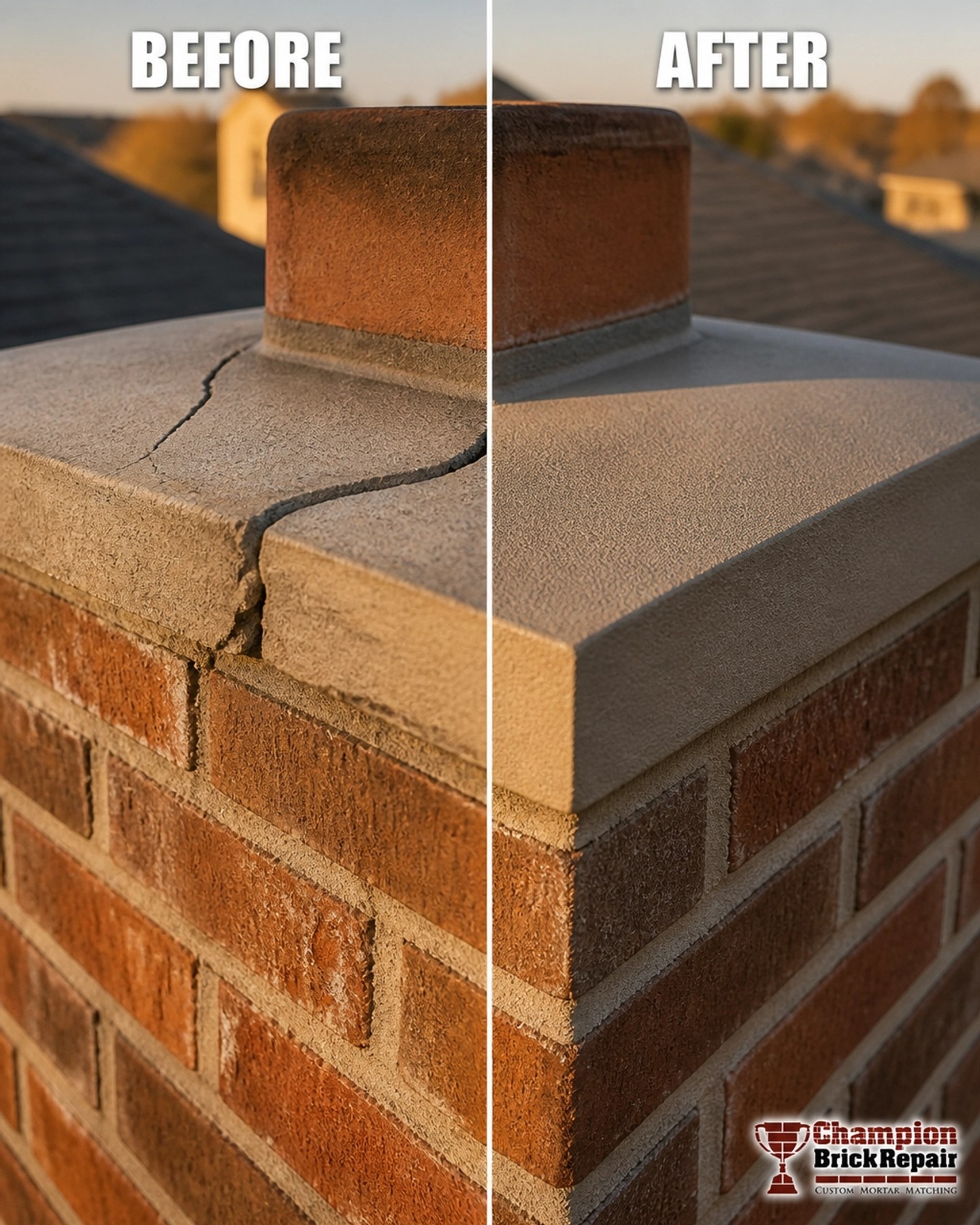
The concrete crown — the slab cap on top of your chimney — takes the worst beating of any masonry on your house. Full sun, driving rain, freeze-thaw cycles, and heat from the flue all hit that one slab. Sooner or later it cracks, and a cracked crown is not a cosmetic problem. Every crack is a funnel that sends water straight down into the chimney core, where it rots mortar from the inside out.
A proper crown rebuild is not a smear of caulk or a skim coat over the old slab. The failed crown gets removed, formwork goes up, reinforcement goes in, and a new crown gets poured with a proper overhang past the brick and a slope that sheds water instead of pooling it. The drip edge — that small lip under the overhang — is what keeps runoff from running straight down your chimney faces and staining them.
We covered the crown in depth in our guide to chimney crown repair. If your crown is the only failing part, fixing it early is the cheapest structural repair a chimney will ever need.
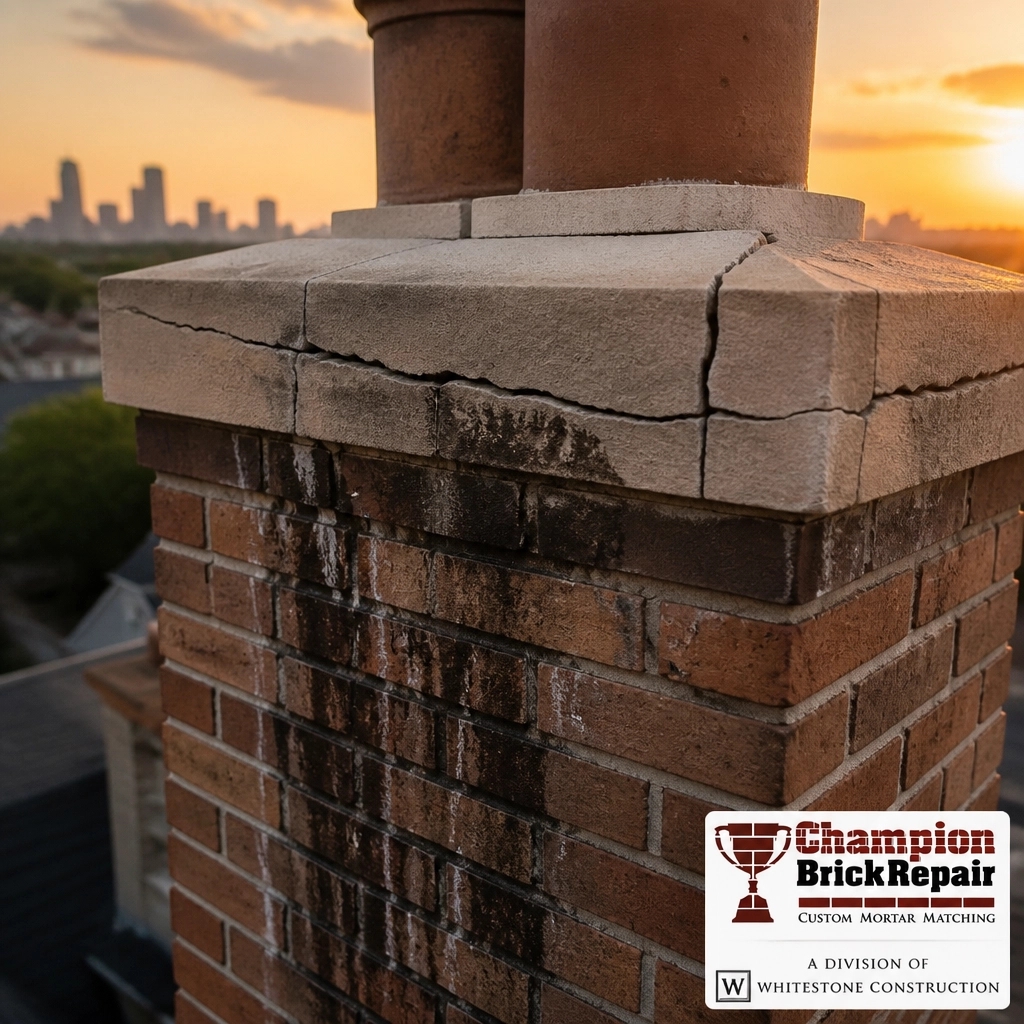
Above the roofline, chimney mortar lives a hard life. The same freeze-thaw and heat cycling that cracks crowns also works joints loose, and once joints open up, water follows. Chimney repointing follows the same standard as any real tuckpointing work: the failed joints get ground out to a proper depth — about five-eighths of an inch — the joints get cleaned and dampened, and new mortar gets piped in, tooled, and finished. On a chimney, the mortar also gets custom-matched to the existing wall so the repair does not read as a patch from the street.
What you do not want on a chimney is a surface smear. Painting new mortar over failed joints without grinding them out is the fastest way to guarantee the repair fails within a couple of seasons — the new skin debonds, water gets behind it, and the next freeze pops it off. Our breakdown of why real repointing starts with a grinder applies double on a chimney, because chimney joints fail faster than wall joints do.
Two more parts, both about keeping water out of places it should never be.
The flue cap sits over the flue opening and does two jobs: it keeps rain from falling straight down your flue, and it keeps animals and debris out. A missing, rusted-through, or undersized cap means every storm sends water down into the firebox and the flue liner. When we rebuild a crown, the cap gets checked and replaced if it is not doing its job — a new crown with a dead cap is half a repair.
Flashing is the metalwork where the chimney meets the roof, and it is the part homeowners almost never think about until water shows up on the ceiling. Good flashing is stepped into the mortar joints and sealed properly. Failed flashing looks fine from the ground right up until it does not. Any honest chimney repair includes eyes on the flashing, because a perfect chimney with bad flashing still leaks.
This is the question that decides the scope of your job, so here is how a mason actually reads a chimney:
Repointing is enough when the brick itself is sound — faces intact, units solid — and the damage is limited to cracked crowns, open joints, and surface wear. The structure is good; the weatherproofing failed.
A partial rebuild is needed when brick faces are spalling off in flakes, individual bricks are loose or crumbling, or the damage runs several courses deep. The bad masonry comes out and gets rebuilt to match.
A full rebuild from the roofline up is needed when the chimney is leaning, the core is saturated and failing, or so much brick is compromised that repointing would just be decorating a teardown.
Be wary of any quote that jumps straight to a full rebuild without explaining which of these conditions your chimney actually meets. And be equally wary of a cheap repoint quote on a chimney with spalling, loose brick — that job needs masonry, not mortar.
White powdery staining (efflorescence) on the chimney faces — water is moving through the masonry.
Brick faces flaking or popping off — spalling, usually from trapped moisture and freeze cycles.
Visible cracks in the concrete crown, or pieces of the crown missing.
Mortar joints that are crumbling, receding, or falling out in chunks.
Rust streaks running down the chimney — often a failing cap or flashing bleeding onto the brick.
Water stains on the ceiling near the fireplace, or a damper that sticks — both can trace back to chimney water entry.
If you are seeing two or more of these, the chimney is telling you the story. Listen before winter does the rest of the talking.
Irving chimneys do not get a gentle life. Summer heat bakes the crown and cooks the joints. Storm season drives rain sideways into every opening. And the freeze-thaw cycles — even the short ones North Texas gets — are brutal on saturated masonry: water expands about nine percent when it freezes, and it does that inside your mortar joints and brick faces. A small crack in October becomes a spalled face by February. That is why fall is the repair window — fix the water entry before the cold turns it into structural damage.
A real chimney repair is a system, not a single line item: crown, joints, cap, and flashing, each checked and fixed on its own merits. When you get estimates, ask each contractor to name which of the four your chimney needs and why. The one who can walk you through it in plain language is the one who will fix it right.
For related reading, see our chimney crown repair guide and how real repointing is done. And if you are in Irving, our Irving brick repair page covers everything we do in your area.
Champion Brick Repair is a division of Whitestone Construction, Hamilton, Texas, and is not affiliated with any other companies using similar names.
Chimney showing cracks, stains, or crumbling joints in Irving?
Call or text photos: (817) 523-1540
Website:championbrickrepair.com
Estimate:quick and easy free online estimate
Review our work:Google Review page
Crown, joints, cap, flashing — let Champion Brick Repair check all four and fix what is actually failing, with a lifetime warranty.