October 12, 2026 · By Champion Brick Repair
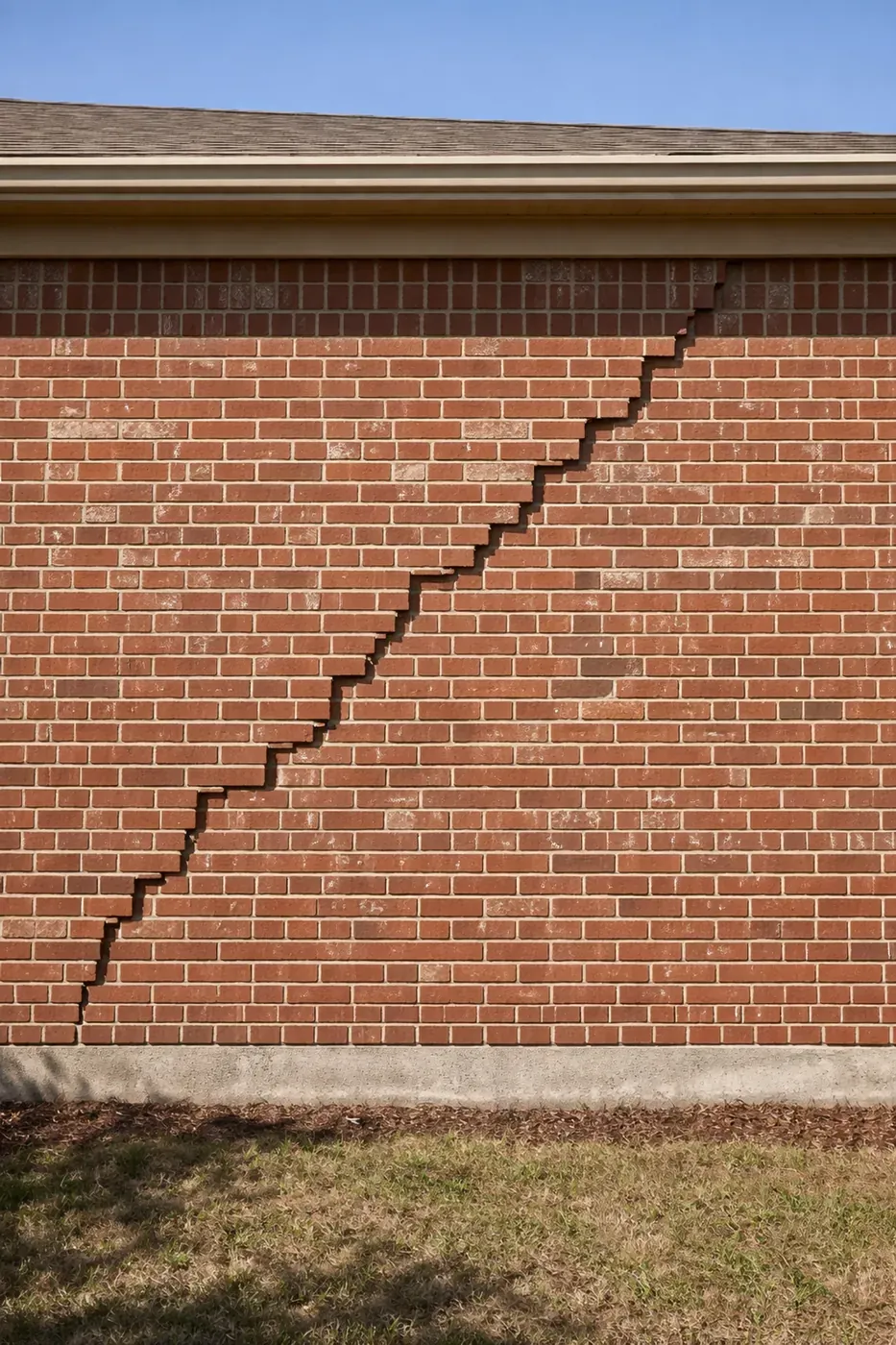
If your Dallas brick wall looks like it is leaning outward — bowing in the middle like a sail catching wind, or drifting away from the house at the top — the problem is probably not your foundation. It is the wall ties. The brick face on your home is not structural. It is a veneer: one layer of brick standing about an inch off the wood framing, and the only things pinning it to your house are small corrugated metal ties buried in the mortar joints. When those ties rust away, the wall starts traveling on its own.
This is one of the most under-diagnosed failures in North Texas masonry. Homeowners get told they need foundation work, or a cosmetic repoint, when the real problem is a wall that is no longer attached to the house.
A brick veneer wall is a single wythe of brick separated from the backup wall by an air cavity, usually about an inch wide. That cavity is part of the drainage design — water that gets through the brick is supposed to run down the back of it and exit through weep holes. But the cavity also means the brick is not bearing on anything except itself. Everything holding that wall to your house is the tie grid.
Wall ties are corrugated strips of galvanized steel. One end is embedded in a mortar bed joint; the other is screwed or nailed to the studs. Building practice calls for roughly one tie per couple of square feet of wall — a grid every 16 to 24 inches, tightened up at openings, corners, and the top of the wall where wind loads are highest.
It is a simple, effective system — until the steel gives up. Galvanized coating buys decades, not forever. And in a wall that stays wet, "decades" gets shorter in a hurry.
Ties corrode, and corrosion needs two things: steel and persistent moisture. Dallas walls supply both in abundance.
Failed or missing flashing. When through-wall flashing was never installed or has broken down, cavity water sits against the ties instead of draining out. Read our guide on through-wall flashing and how drainage planes fail — the same failures that rot flashing kill ties.
Missing, clogged, or painted-shut weep holes. Weeps are the exit. Seal the exit and the cavity becomes a bathtub, and the ties live underwater. Our breakdown of weep holes and how to check yours shows the five-minute inspection.
Mortar droppings damming the cavity. Squeezed-out mortar piles up in the air gap during construction and traps water against the ties in exactly the wrong places.
Texas clay movement. Expansive soil cycles stress the whole wall system season after season. Micro-movement cracks the galvanized coating at the tie's bend points, and rust starts where the coating breaks.
The math that matters: most of the brick veneer in Dallas went up between the 1960s and the 1990s. A galvanized tie in a wall that stays wet can be substantially corroded in 25 to 40 years. A lot of these walls are in that window right now.
Failed ties show up as movement, not as rust you can see — the ties are buried, so you read the wall:
A bulge or bow in the middle of a wall run. The veneer bellies outward where the ties are gone and the wall is standing on its own.
The veneer leaning out at the top. Look where the brick meets the eave or soffit. A gap opening there means the top courses have lost their anchorage — the most dangerous zone, because the top is where wind load hits hardest.
Long horizontal cracks following one mortar bed. Step cracks get the attention, but a straight horizontal crack running many feet along a single bed joint is the classic tie-line failure signature.
Gaps opening at window frames, door frames, and trim. The veneer is drifting away from the openings it used to bear against.
Rust staining at the weep holes. The one visible rust clue — corroded ties bleeding rust out through the drainage path.
The push test. Press the wall gently with your palm in the suspect area. If the brick moves and the house does not, the ties in that zone are gone. Do not shove hard — a loose veneer is heavy, and you do not want to be the one who finds out how loose.
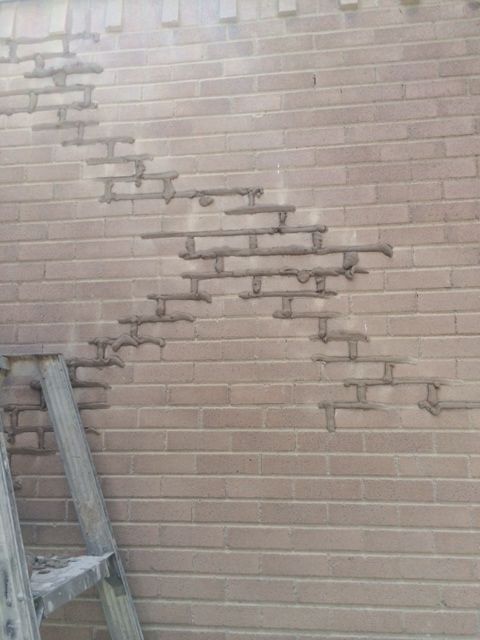
One honest note: hairline step cracks alone do not prove tie failure — they can come from settlement or lintel movement too. The bulge, the lean at the top, and the push test are what separate a tie problem from the other usual suspects.
This is where good money gets wasted. A wall with failed ties gets quoted for a cosmetic repoint: grind the cracks, pipe in fresh mortar, wash it down. It looks great for a season. Then the veneer keeps moving, the new mortar cracks right back open, and the wall is still unattached to the house.
Fresh mortar does not anchor anything. It is a weather seal, not a structural connection. Repointing a tie-failed wall without re-anchoring it is the masonry version of painting over a check-engine light.
Worse, an unanchored veneer is a falling-brick hazard. A wall that can be felt moving by hand is a wall that can come down in a wind event. This is not a repair to schedule "sometime next year."
Re-anchoring a veneer wall means giving it a new tie grid — one that will outlast the wall:
Map the failure first. The wall gets surveyed course by course: where is it moving, where are the original ties still holding, where is the cavity bridged with mortar droppings. The re-anchor grid is engineered around what is actually there, not guessed from the sidewalk.
Install remedial ties on a proper grid. Stainless helical ties are driven through the mortar joints and into the studs or backup wall, restoring the connection the original ties used to provide. Stainless — not plain galvanized — because the new ties are going back into a wall that already proved it can kill steel.
Seal every penetration. Each tie entry gets sealed so the fix does not become a new water path into the cavity.
Repoint the disturbed joints with matched mortar. The tie work disturbs joints along the way; those get repointed with mortar custom-blended to the existing wall — softer than the brick, matched before it ever goes in — so the structural repair disappears into the wall.
Fix the water problem that killed the first set. New ties in a wall that still ponds water are on the same countdown as the old ones. The drainage plane gets corrected at the same time: flashing restored, weeps opened, mortar bridges cleared.
In the worst cases — a veneer that has bellied several inches out or lost whole sections of anchorage — the honest fix is partial dismantling and rebuild of the failed zone with a new tie grid built in from the start. A contractor who proposes re-anchoring without ever discussing the water source is selling you the second failure, not the fix.
How will you verify how many original ties are still holding?
What is the remedial tie grid — spacing, pattern, and how is it anchored to my backup wall?
Stainless or galvanized ties — and why?
How do you seal the tie penetrations against water entry?
Will the disturbed mortar be custom-matched to my wall?
What is putting water in my wall, and what changes in your repair?
If your Dallas brick wall is bowing, leaning, or moving under your hand, send photos and get a straight answer about what is actually holding it up. For related information, see Champion's brick repair services in Dallas.
Champion Brick Repair is a division of Whitestone Construction, Hamilton, Texas, and is not affiliated with any other companies using similar names.
Wall moving? Get a straight answer before it becomes a falling-brick problem.
Call or text photos: (817) 523-1540
Website:championbrickrepair.com
Estimate:quick and easy free online estimate
Review our work:Google Review page
A wall that moves is a wall that needs anchors — let Champion Brick Repair pin yours back to the house.