October 8, 2026 · By Champion Brick Repair
If you own a Dallas home with brick arches over the windows or doors, look at them closely the next time you walk up to your front door. If the arch is dropping at the center, the joints above it are cracking open, or a wedge-shaped gap has appeared near the top, that arch is losing its structural integrity.
The good news: a sagging arch does not always mean tearing out the whole arch and rebuilding it. There is a proven structural repair called helical stitching that rebuilds the arch from inside the mortar joints — and it is one of the most trade-honest fixes in masonry repair.
A brick arch over a window or door is not decoration. The wedge-shaped bricks (voussoirs) are cut and laid so that the weight of the wall above them gets funneled sideways and down into the supports on each side of the opening.
As long as every brick stays wedged tight, the arch carries its load. The moment a brick slips or a joint opens, the arch starts to act like a row of loose bricks with nothing holding the middle up.
The failure pattern is consistent:
The center of the arch (the keystone area) drops while the sides stay put
Mortar joints above the arch open in a V pattern or a vertical line
A hairline crack follows the curve of the arch through the brickwork
Previous repairs — caulk, surface mortar, or paint — crack back open within months
Behind many of these, there is a hidden cause: a steel lintel or support angle behind the arch that has rusted, expanded, and pushed the brickwork out of alignment. That is the same rust-and-expansion failure we see in sagging garage lintels, just wearing a prettier face. Water getting into the joints, Texas clay soil movement, and decades of thermal expansion and contraction finish the job.
Helical stitching is exactly what it sounds like: the mason sews the cracked wall back together with stainless steel.
Here is the sequence, step by step:
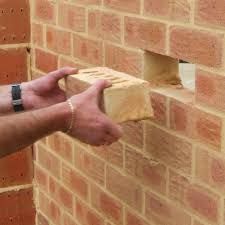
Loose brick along the crack is chipped out carefully with a hammer and cold chisel. Every loose fragment comes out — new steel is never installed over unsound masonry.
An angle grinder cuts clean, horizontal slots in the mortar joints, running across the arch and the crack line. The slots run perpendicular to the crack so the steel bars will bridge it, the same way a stitch crosses a seam in fabric.
Twisted helical steel bars — the signature material — are bedded into the slots. The twisted shape locks into the masonry better than a smooth bar ever could, and the stainless steel will not rust and expand the way the original lintel steel did.
Structural grout or matching mortar is injected over the bars, filling the slots completely. The steel disappears into the joint — it becomes part of the wall's structure instead of a visible patch on its face.
The filled slots are tooled and finished to match the surrounding joints. When it is done right, the repair is nearly invisible: the arch looks original, but it now has steel reinforcement running through its weakest lines.
A full arch rebuild means removing every brick in the arch, building temporary support, and relaying each brick — often with matching brick that is hard to source. For a typical residential arch, that is heavy work and a heavy bill.
Helical stitching avoids the tear-out entirely. The arch stays in place. The repair works inside the joints, so the face of the wall is preserved. For the arch failures we see most often — dropped keystone, cracked joints, early-stage sag — stitching restores real structural strength at a fraction of the disruption.
Be straight with yourself before you call anyone: stitching has limits. A contractor who tells you everything can be stitched is selling, not diagnosing.
Collapsed or badly displaced arch: if bricks have fallen or the arch has dropped significantly, the geometry is gone — it must be rebuilt.
Crushing brick: if the brick units themselves are cracking under load (not just the joints), steel in the joints cannot save them.
Rotted support behind the arch: if the hidden steel angle or support has failed completely, the structural support has to be addressed, not just the brickwork around it.
Severe wall displacement: if the whole wall section is rotating or bulging, the arch is a symptom of a foundation or framing problem — fixing the symptom alone is wasted money.
This is why a real diagnosis comes before a real proposal. A mason who grinds out, stitches, and repoints without checking what is behind the arch is doing cosmetic work with a structural price tag.
Stitching is a structural repair, but the finish is a cosmetic one. The slots get repointed, and if the new mortar does not match the existing wall in color, texture, and tooling profile, the repair will look like a grid of patches across the front of your home.
Learn why mortar should be matched for compatibility, not just color — and why proper joint preparation starts with grinding, not a tube of caulk.
A sagging brick arch is the wall telling you the load path is failing. Listen to it early, and helical stitching can restore that load path without tearing your arch apart. Wait until bricks are dropping, and you are rebuilding.
For related information, see our Dallas brick repair services.
Concerned about a sagging arch over a window or door? Text us photos and we will tell you whether it is a stitching repair or a rebuild.
Call or text photos: (817) 523-1540
Website: championbrickrepair.com
Estimate: Get a free estimate
Sagging arches do not fix themselves. Get a structural diagnosis — not a patch — from Champion Brick Repair.