October 17, 2026 · By Champion Brick Repair
If you are searching for spalled brick repair near me in Mansfield, TX, you are probably looking at brick faces that are flaking, peeling, or popping off in flat pieces — and Mansfield homeowners see plenty of it on walls that take hard sun, sprinkler spray, and North Texas freeze nights in the same season. Spalling is not a paint problem and it is not fixed with a coating. It is the brick itself breaking down at its face, and the repair starts with understanding why that face gave up.
A sound brick has a hard, fired outer skin. That skin is the brick's weather coat: it sheds water while the softer interior stays protected behind it. Spalling starts when water gets into the brick — through open joints, a hard repair mortar that traps moisture, or a damaged face — and then has nowhere to go. When that trapped water freezes, it expands inside the brick and pushes the face outward. Cycle after cycle, the face loosens, flakes, and finally pops off in a shallow shell, leaving the softer core exposed to take weather directly. From there the damage speeds up, because the core was never meant to be the surface.
Brick and mortar are supposed to breathe. A wall takes on a little water in a storm and dries back out through its joints. When joints are sealed over with a hard, cement-rich repair mortar — stronger and less permeable than the brick — moisture that gets behind it is trapped in the units instead. That is why the central rule of mortar matching 101 matters here: repair mortar should be softer than the brick, so the joint stays the sacrificial, breathable part of the wall instead of the brick face becoming it.
A brick face nicked by a string trimmer, cracked by impact, or stripped by harsh cleaning loses its fired skin at that spot. Water enters through the break, and spalling often starts exactly there and spreads to neighboring units that share the same wet joints.
A sprinkler head soaking the same low courses every other day, or soil and mulch built up against the wall, keeps those brick wet far longer than rain alone ever would. In Mansfield, some of the worst spalling we are asked about sits right at sprinkler height on otherwise sound walls. The wall never gets a chance to dry, so every freeze works on a saturated brick.
Flakes and shallow shells on the ground or in the bed below the wall. Flat pieces of brick face, roughly the thickness of a wafer to a small plate, are the clearest sign — that material used to be the front of a brick.
Faces that look scooped, pitted, or layered. A spalling brick loses its flat face in scales. Run a hand over it: sound brick feels hard and even, spalling brick feels crumbly and sheds grit.
Damage clustered low, or around one wet area. Spalling that follows a sprinkler arc, a leaking gutter line, or a shaded section that stays damp is water-driven, not age-driven.
Joints that are hard, raised, and intact while the brick around them fails. When the mortar looks perfect and the brick are dying, the mortar is very likely the problem — it is outlasting the wall it was meant to protect.
White powder alongside the flaking. Efflorescence means water is moving through those units and carrying salts out — the same water that freezes in winter and pops faces off.
Smearing mortar or patch compound over a spalling face buries a brick that is still coming apart. The patch bonds to a surface that is itself separating, so the patch comes off with the next layer of face — usually within a season or two, and usually taking a little more brick with it. Coatings and sealers can make it worse: a film that slows drying traps the moisture already in the wall behind the damaged face, which is the exact condition that caused the spall. Our guide to what sealing your brick can and cannot do walks through where breathable protection helps and where a coating becomes a trap. A spalled brick is not a surface problem to cover. It is a failed unit to replace, plus a water cause to correct, or the replacement will follow it.
Map the damage and find the water source first. Every spalled unit is marked, and the sprinkler, gutter, joint, or mortar condition feeding water into that section is identified before any brick come out. Replacing brick into the same wet conditions is a short-lived repair.
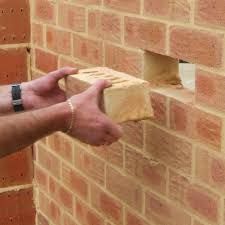
Remove the failed units cleanly. Spalled brick are taken out without chewing up their sound neighbors, and the pocket is cleaned back to solid material so the new unit beds fully.
Match the replacement brick. Size, color range, and texture are matched as closely as the surrounding wall allows, so the repair reads as wall, not as a patch — a few new units scattered through a weathered wall should disappear at street distance.
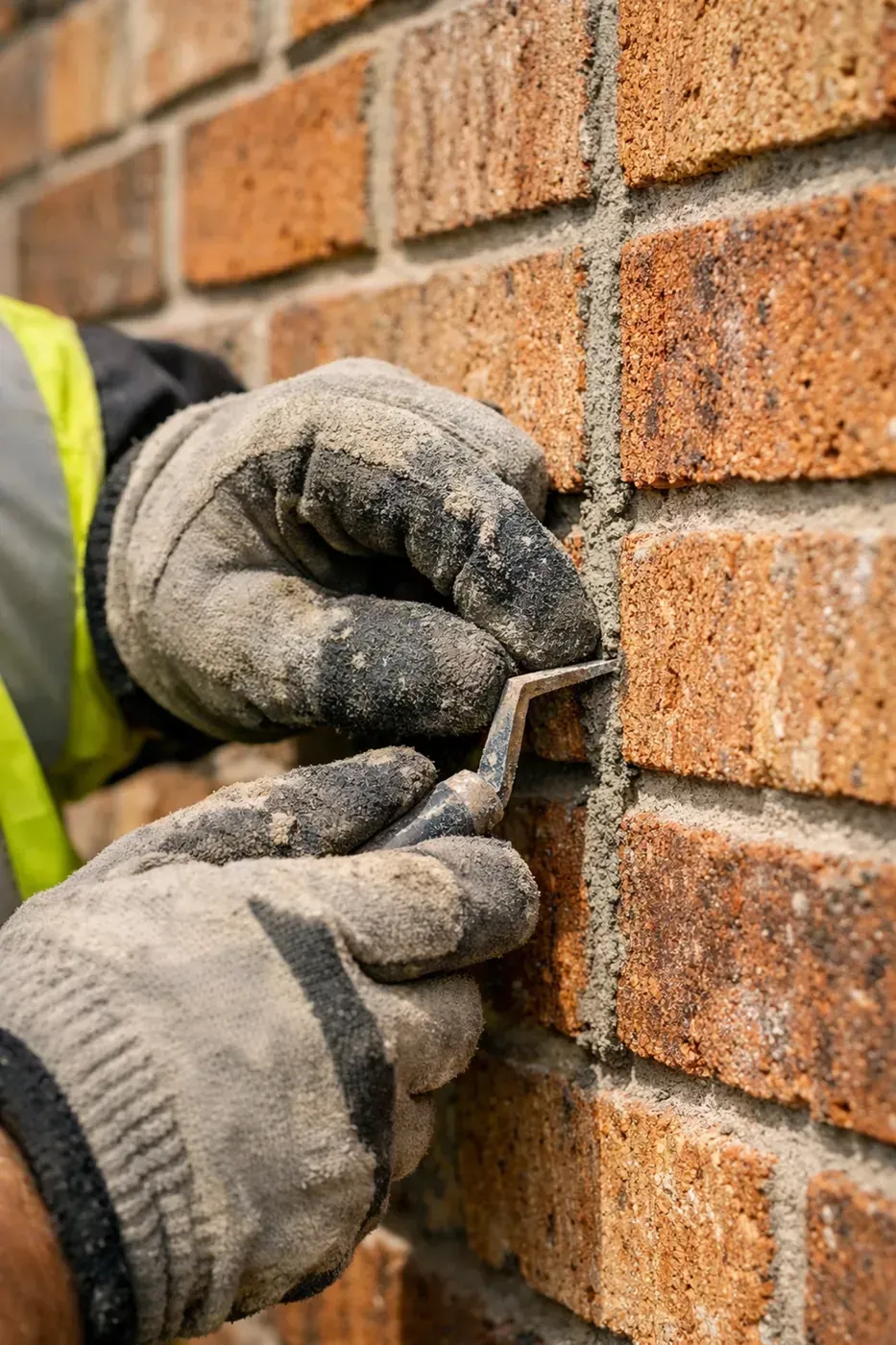
Relay with mortar matched before it goes in the bag. Replacement brick are set on full beds with mortar custom matched for color and texture, kept softer than the brick and more permeable, so the wall can dry through its joints again. Joints around the work that have failed are ground out about 5/8 inch, cleaned, and dampened before repointing so new mortar bonds instead of sitting on dust.
Correct the water habit and finish clean. Sprinkler aim, soil height, or a gutter drip feeding the section gets addressed as part of the conversation, joints are tooled to match the surrounding profile, brushed, and the face cleaned. Where a wall has also opened vertical joints from movement, our piece on expansion joint failure in Fort Worth brick veneer explains how that separate problem is handled.
A handful of spalled units around one sprinkler head, caught while their neighbors are still hard-faced and sound, is a targeted replacement job. Spalling spread across a whole elevation, with grit shedding from most faces and joints that no longer match the brick's needs, is a section problem: the wall's moisture conditions have been wrong for years, and replacing brick one at a time as they pop becomes a subscription instead of a repair. The honest test is the hand test and the pattern — isolated and explained, or widespread and systemic. Either way, waiting does not improve it: every exposed core takes weather faster than a faced brick did.
Walk a Mansfield wall after a dry spell and photograph the damaged courses straight-on. Mark sprinkler arcs with a photo while the system runs. That record — which faces are gone, which are starting, and where the water comes from — is exactly what a good estimate is built on. Our Mansfield brick repair page covers the work we do across the city.
What is putting water into these brick, and does the repair address it?
Are the failed units being replaced, or patched over?
How are the replacement brick and mortar being matched — and is the mortar softer than the brick?
Is anyone telling you to coat the wall? Ask what happens to the moisture already inside it.
If brick faces are flaking or popping off a Mansfield wall, get the failed units replaced and the water cause named while the damage is still a section, not an elevation. The face is the warning. The water is the repair.
Champion Brick Repair is a division of Whitestone Construction, Hamilton, Texas, and is not affiliated with any other companies using similar names.
Brick faces flaking, pitting, or popping off? Get the damaged units mapped and the water source named before more faces let go.
Call or text photos: (817) 523-1540
Website:championbrickrepair.com
Estimate:quick and easy free online estimate
Review our work:Google Review page
Spalled brick faces do not heal under a coating — let Champion Brick Repair replace the failed units and name the water cause right.